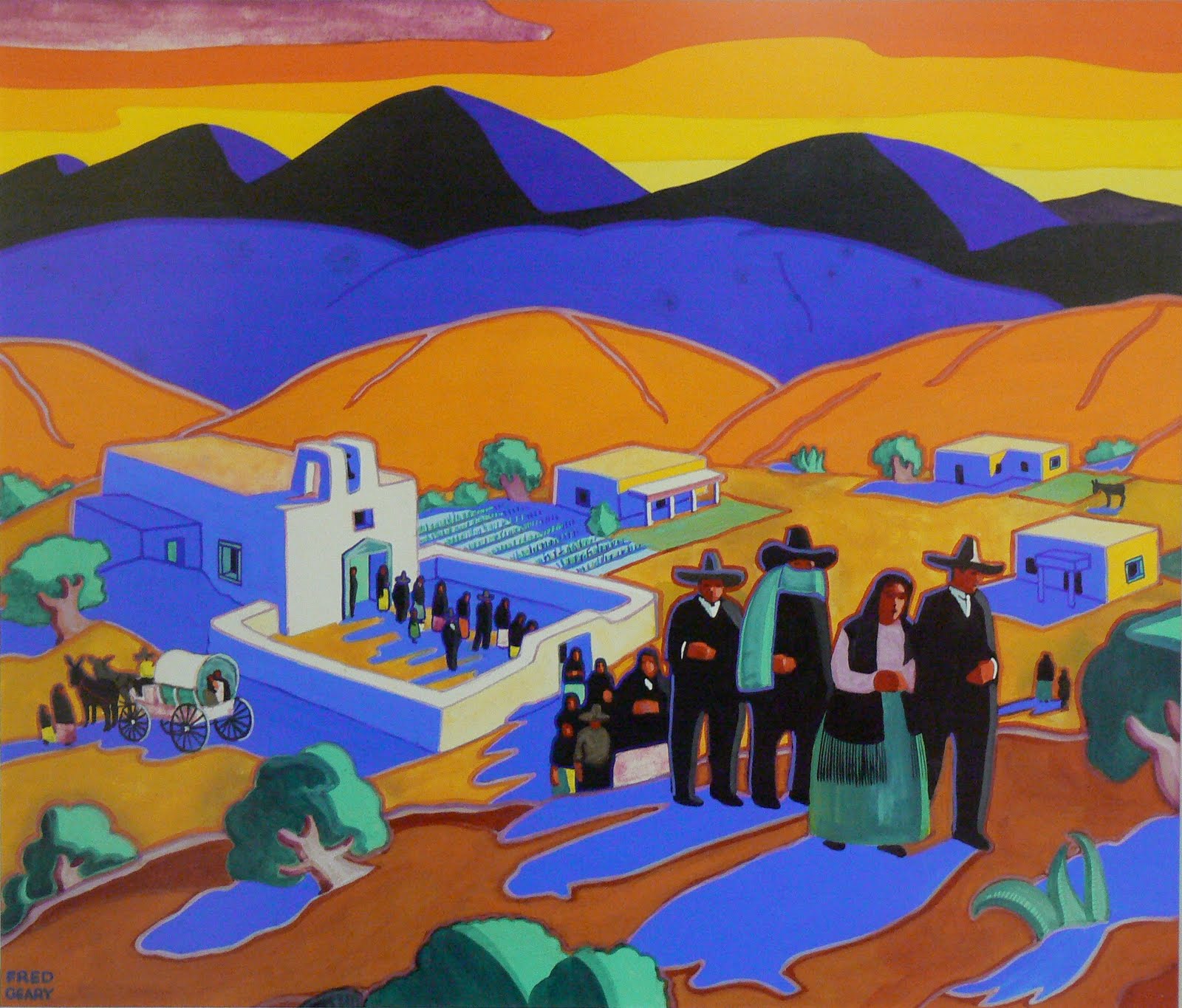
One artist creates from materials and keeps it out of public view. Another artist looks for places where his work can be seen by others. He may enter his work into a "no jury" exhibition, where "everything" is accepted, and no entry is rejected. He may pay money to be part of a group that will show his work on a rotating basis. These opportunities are valid and have their place. Getting exposure in public is important if you want others to know what kind of art you do, and gain collectors for your work. But the artist who submits his work into a "juried" competition has his work measured by certain standards, looked over and judged by a jury of professionals in a given field. That work is then included in a group with other accepted works or is turned down and returned to its creator. Risk is involved. There are forms to fill out, shipping expenses, and usually a fee for entry. But those works accepted into a juried exhibition are given special recognition for their skill.
In 1929 Fred Geary had two watercolors accepted in a juried exhibition. Entries came in from the Midwest region, including Missouri, Kansas, Oklahoma, Nebraska, and Colorado. Two hundred and ninety-three entries were accepted by the jury. And about the same number of other entries were turned away. The Kansas City Art Institute hosted the event and acquired art department directors from Colorado, Nebraska, and Oklahoma to do the judging. Categories included oil paintings, watercolors, sculpture, metalwork, jewelry, terracotta, textile decoration, batik, leather work and book binding, and prints created by dry point, etching, lithograph, linoleum cuts, and woodcuts.
In 1931 Geary had his first woodcut accepted in the exhibition. Since the annual exhibitions began in 1922, it is likely that Geary saw woodcuts made by other print makers from the previous years. He may have talked to and become friends with some of them. Here is a list of those print makers, the specific print medium entered, and accepted titles. When possible I have included a link or example of a work by that print maker.
Who influenced Geary has yet to be determined. But it is known that in the Middle West region many people were producing woodcut entries. Click on images to see them larger.
Sheila Ellsworth Burlingame (1894-1969) was a painter, block printer, and later a sculptor. Her given address was 3664 Washington Ave, St. Louis, Missouri. She had TEN ACCEPTED WOODCUTS in the 1922 exhibit. Those included Waterfall, Sketch, The Matador, Tight Rope Artist, Cinderella, Adam and Eve, The Siesta, Snake Charmer, Between Acts, Sun Dancer.
Her "Sun Dancer" received a Gold Medal for Graphic Arts from the KCAI Guild, and was owned by Mary Powell of St. Louis.
 A sample of her woodcuts can be seen in "From The Day's Journey" by Harry Rosecrans Burke, published in 1924 by the William Harvey Miner Company. Block images ranged in size from 5 1/2" by 4 1/2 inches to 11 by 16 inches.


 William Marion Reedy
A Portrait Study - woodcut (p.48)
 Midsummer Night
And A Slum
excerpt from Harold Burke (p. 76)
 Garden Glimpse
An Impression - woodcut (p.60)
 Nocturne
In Black And Gold
excerpt from Harold Burke (p.31)
 The Pain Killer - woodcut (p.30)
Burlingame created woodcuts for the St. Louis Dispatch newspaper from 1923 - 1924, according to Susan V. Craig, Art librarian of the University of Kansas.(accessed Friday, September 10th, 2010 from http://kuscholarworks.ku.edu/dspace/bitstream/1808/1028/1/BDKAversion1.pdf.)


 (above text courtesy of Jason D. Stratman, Assistant Reference Librarian, Missouri History Museum, St. Louis, MO, received by mail November 2, 2010)
Harry Muir Kurtzworth (1887-1979) had one xylograph (or woodcut) accepted in the 1922 show entitled "Quietude," along with two pastels. He served as director of the Kansas City Art institute from 1922 to 1924. FIVE of his color wood block prints were accepted in the 1919 exhibition with twenty-two American Artists at the Detroit Institute of The Arts. ("A History Of Community Achievement, 1885-1964," courtesy of Jannes Library, Kansas City Art Institute, 4538 Warwick Boulevard, Kansas City, MO, accessed Saturday, October 9th, 2010; Detroit Institute, accessed Friday, September 10th, 2010)
Sven Birger Sandzen (1871-1954) of Lindborg, Kansas had three lithographs in the 1922 show. His piece, Grand Canyon, was awarded the J.C. Nichols Purchase Prize for Graphic Arts.
Loran Frederick Wilford (1893 - 1972) had two linoleum cuts accepted, The Old Tavern, Going To The Market. The latter was awarded the Silver Medal for Graphic Arts, 1922. His given address was 4115 Forest Avenue, Kansas City.
1923
Anderson Craig,
2020 Tracy, Kansas City
Wood Block
Ferdinand E. Warren
3842 E. Tenth St, Kansas City
Palisades-wood block
The Bridge-wood block
The Old Mill-wood block
awarded KCAI Bronze Medal for Graphic Arts, 1923
Margaret Whittemore (1897-1983),1615 College Ave, Topeka, KS
Pueblo Indians-wood block
In 1929 Fred Geary had two watercolors accepted in a juried exhibition. Entries came in from the Midwest region, including Missouri, Kansas, Oklahoma, Nebraska, and Colorado. Two hundred and ninety-three entries were accepted by the jury. And about the same number of other entries were turned away. The Kansas City Art Institute hosted the event and acquired art department directors from Colorado, Nebraska, and Oklahoma to do the judging. Categories included oil paintings, watercolors, sculpture, metalwork, jewelry, terracotta, textile decoration, batik, leather work and book binding, and prints created by dry point, etching, lithograph, linoleum cuts, and woodcuts.
In 1931 Geary had his first woodcut accepted in the exhibition. Since the annual exhibitions began in 1922, it is likely that Geary saw woodcuts made by other print makers from the previous years. He may have talked to and become friends with some of them. Here is a list of those print makers, the specific print medium entered, and accepted titles. When possible I have included a link or example of a work by that print maker.
Who influenced Geary has yet to be determined. But it is known that in the Middle West region many people were producing woodcut entries. Click on images to see them larger.
 |
| The Railroads - left leaf of book liner |
 | |||||
| The Railroads - right leaf of book liner |
Her "Sun Dancer" received a Gold Medal for Graphic Arts from the KCAI Guild, and was owned by Mary Powell of St. Louis.
 |
| Front Cover- Woodcut |
 |
| Back Cover -Woodcut |


A Portrait Study - woodcut (p.48)

And A Slum
excerpt from Harold Burke (p. 76)

An Impression - woodcut (p.60)

In Black And Gold
excerpt from Harold Burke (p.31)

Burlingame created woodcuts for the St. Louis Dispatch newspaper from 1923 - 1924, according to Susan V. Craig, Art librarian of the University of Kansas.(accessed Friday, September 10th, 2010 from http://kuscholarworks.ku.edu/dspace/bitstream/1808/1028/1/BDKAversion1.pdf.)
 |
| (woodcut image courtesy of Jason D. Stratman, Assistant Reference Librarian, Missouri History Museum, St. Louis, MO, received by mail November 2, 2010) |


Harry Muir Kurtzworth (1887-1979) had one xylograph (or woodcut) accepted in the 1922 show entitled "Quietude," along with two pastels. He served as director of the Kansas City Art institute from 1922 to 1924. FIVE of his color wood block prints were accepted in the 1919 exhibition with twenty-two American Artists at the Detroit Institute of The Arts. ("A History Of Community Achievement, 1885-1964," courtesy of Jannes Library, Kansas City Art Institute, 4538 Warwick Boulevard, Kansas City, MO, accessed Saturday, October 9th, 2010; Detroit Institute, accessed Friday, September 10th, 2010)
Sven Birger Sandzen (1871-1954) of Lindborg, Kansas had three lithographs in the 1922 show. His piece, Grand Canyon, was awarded the J.C. Nichols Purchase Prize for Graphic Arts.
Loran Frederick Wilford (1893 - 1972) had two linoleum cuts accepted, The Old Tavern, Going To The Market. The latter was awarded the Silver Medal for Graphic Arts, 1922. His given address was 4115 Forest Avenue, Kansas City.
1923
Anderson Craig,
2020 Tracy, Kansas City
Wood Block
Ferdinand E. Warren
3842 E. Tenth St, Kansas City
Palisades-wood block
The Bridge-wood block
The Old Mill-wood block
awarded KCAI Bronze Medal for Graphic Arts, 1923
Margaret Whittemore (1897-1983),
Pueblo Indians-wood block
1924
Leo Courtney, Wichita, KS
Dusk---wood block $4
River---wood block $5
The Hilltop--wood block $5
Henri W. Domshydt,
Dusk---wood block $4
River---wood block $5
The Hilltop--wood block $5
Henri W. Domshydt,
302 Patterson Block, Omaha, NE
Marshal Foch---linoleum cut
Vera B. Leeper,
Marshal Foch---linoleum cut
Vera B. Leeper,
316 W. 14th St, New York City
The Pool----block print $10
Ferdinand E.Warren,
1020 Chestnut St, Kansas City, MO
Visitation Church----woodcut $10
Sebree Bridge----woodcut $7.50
The Pool----block print $10
Ferdinand E.Warren,
1020 Chestnut St, Kansas City, MO
Visitation Church----woodcut $10
Sebree Bridge----woodcut $7.50
Charles Wilimovsky,
1840 Blue Island Ave, Chicago, Ill
2 oils, 4 etchings
The Fisherman's Shack---linoleum cut,
awarded 1924 Purchase Prize for Black and White
The Chicken Barn----linoleum cut $10
1926
Herschel C. Logan (1901-1987)
C.A. Seward
Ferdinand E. Warren
KCAI Instructor for etching Adolphe W. Blondheim
1927
Walter Bailey,
Art Dept. Kansas City Star
The Old Swimming Hole---etching
Snow Capped Mountain---linoleum print
George L. Cartlich,
3116 Flora Ave, Kansas City, MO
The Wharf---Linoleum Print
Just Where Is This---Linoleum Print
William Dickerson, Wichita
The Book Shop---Linoleum Print
David F. Leavitt,
North 12th Blvd, St. Louis, MO
Book-plate---Linoleum Print
Enchantment---Linoleum Print
Self-Portrait---Linoleum Print
C.C.Frederick---Linoleum Print
Herschel C. Logan, Wichita
Deserted Barn---woodcut
Mexican Farmyard---woodcut
Church in The Valley---woodcut
Old Mission, Rancos de Taos--- woodcut-bronze Medal
C.A.Seward, Wichita
Canada Goose---lithograph
Old Willow---lithograph
Big Pines--Raton Pass---Block Print
Toadstool Rock-Santa Fe---Lithograph_Silver Medal(
scroll down on this link site for his Toadstool Rock lithograph)
KCAI Instructor for etching Anthony Angarola (1893-1929)
1928 KCAI instructors the year Geary may have enrolled when the school was at 3500 Warwick Blvd.
Anthony Angarola-Life painting and portraiture drawing
John D. Patrick----Drawing, Advanced Antique
Austin Ketcham---Design and Cast Drawing
W.W.Rosenbauer--Sculpture and Crafts
Russel M. Wise--Interior Decoration
1928
3500 Warwick Blvd., Kansas City, MO
Rosa Bear,
2620 West 32nd Ave, Denver, Colo.
The Silent Mill---Linoleum Print
Albert Benson,
University of Nebraska-Lincoln
Landscape Sketch---Drypoint etching
East 39th Street, New York---Aquatint
Ivan Cloud, Kansas City, MO
Chivary---Block Print
Leo Courtney
Shadows---Woodcut
Afterglow---Woodcut
Winter---Color Print
The Homestead---Woodcut wins Bronze Medal award
William J. Dickerson, Wichita, Kansas
The Sand Boat---Woodcut
Alice R. Edmiston,
1900 South 40th Street, Lincoln, Nebraska
Wharf of Provinceton---Woodcut
Lake Como, Italy---Woodcut
Mercedes Erixon,
Norman, Oklahoma
Gurgling Water---Woodcut
Summer Sunlight---Woodcut
Herschel C. Logan
The Weaver---Woodcut
Lost Hope---Woodcut
1929
When the school was at 4415 Warwick Blvd. 293 entries were chosen. Here are the relief prints.
Ina Annette--
University of Oklahoma, Norman, OKL
(Student of Birger Sandzen )

Elephant's Feet---Linoleum Cut
Desert Derelicts---Woodcut
Monumental Valley---Woodcut
Click on Sheep Ranch to see another sample of her work.
Helen Louise Beccard (Niles)
3024 Walton Place, St. Louis, MO
Sicilian Road---Linoleum Print
Old Slave Quarters---Linoleum Print
George Randall Brubaker (1908-1977)
1308 Massachusetts Street, Lawrence, KS
"Old Tenements"---Woodcut
pencil-signed and titled, size 11 in. x 8 in.
Ben Albert Benson.
University of Nebraska-Lincoln
Buck In The Snow---Drypoint Etching
Silhouette---Drypoint Etching
Sheila Burlingame
Spring---Oil painting
The Surf---Woodcut
Design---Woodcut
1840 Blue Island Ave, Chicago, Ill
2 oils, 4 etchings
The Fisherman's Shack---linoleum cut,
awarded 1924 Purchase Prize for Black and White
The Chicken Barn----linoleum cut $10
1926
Herschel C. Logan (1901-1987)
C.A. Seward
Ferdinand E. Warren
KCAI Instructor for etching Adolphe W. Blondheim
1927
Walter Bailey,
Art Dept. Kansas City Star
The Old Swimming Hole---etching
Snow Capped Mountain---linoleum print
George L. Cartlich,
3116 Flora Ave, Kansas City, MO
The Wharf---Linoleum Print
Just Where Is This---Linoleum Print
William Dickerson, Wichita
The Book Shop---Linoleum Print
David F. Leavitt,
North 12th Blvd, St. Louis, MO
Book-plate---Linoleum Print
Enchantment---Linoleum Print
Self-Portrait---Linoleum Print
C.C.Frederick---Linoleum Print
Herschel C. Logan, Wichita
Deserted Barn---woodcut
Mexican Farmyard---woodcut
Church in The Valley---woodcut
Old Mission, Rancos de Taos--- woodcut-bronze Medal
C.A.Seward, Wichita
Canada Goose---lithograph
Old Willow---lithograph
Big Pines--Raton Pass---Block Print
Toadstool Rock-Santa Fe---Lithograph_Silver Medal(
scroll down on this link site for his Toadstool Rock lithograph)
KCAI Instructor for etching Anthony Angarola (1893-1929)
1928 KCAI instructors the year Geary may have enrolled when the school was at 3500 Warwick Blvd.
Anthony Angarola-Life painting and portraiture drawing
John D. Patrick----Drawing, Advanced Antique
Austin Ketcham---Design and Cast Drawing
W.W.Rosenbauer--Sculpture and Crafts
Russel M. Wise--Interior Decoration
1928
3500 Warwick Blvd., Kansas City, MO
Rosa Bear,
2620 West 32nd Ave, Denver, Colo.
The Silent Mill---Linoleum Print
Albert Benson,
University of Nebraska-Lincoln
Landscape Sketch---Drypoint etching
East 39th Street, New York---Aquatint
Ivan Cloud, Kansas City, MO
Chivary---Block Print
Leo Courtney
Shadows---Woodcut
Afterglow---Woodcut
Winter---Color Print
The Homestead---Woodcut wins Bronze Medal award
William J. Dickerson, Wichita, Kansas
The Sand Boat---Woodcut
Alice R. Edmiston,
1900 South 40th Street, Lincoln, Nebraska
Wharf of Provinceton---Woodcut
Lake Como, Italy---Woodcut
Mercedes Erixon,
Norman, Oklahoma
Gurgling Water---Woodcut
Summer Sunlight---Woodcut
Herschel C. Logan
The Weaver---Woodcut
Lost Hope---Woodcut
1929
When the school was at 4415 Warwick Blvd. 293 entries were chosen. Here are the relief prints.
Ina Annette--
University of Oklahoma, Norman, OKL
(Student of Birger Sandzen )
Elephant's Feet---Linoleum Cut
Desert Derelicts---Woodcut
Monumental Valley---Woodcut
Click on Sheep Ranch to see another sample of her work.
Helen Louise Beccard (Niles)
3024 Walton Place, St. Louis, MO
Sicilian Road---Linoleum Print
Old Slave Quarters---Linoleum Print
George Randall Brubaker (1908-1977)
1308 Massachusetts Street, Lawrence, KS
"Old Tenements"---Woodcut
pencil-signed and titled, size 11 in. x 8 in.
Ben Albert Benson.
University of Nebraska-Lincoln
Buck In The Snow---Drypoint Etching
Silhouette---Drypoint Etching
Sheila Burlingame
Spring---Oil painting
The Surf---Woodcut
Design---Woodcut
Leo Courtney
City Hall---Woodcut
William J. Dickerson
Study---Woodcut
Birger Sandzen
Lindsborg, Kansas
watercolor, lithograph, drypoint
C.A. Seward
City Hall---Woodcut
William J. Dickerson
Study---Woodcut
Birger Sandzen
Lindsborg, Kansas
watercolor, lithograph, drypoint
C.A. Seward
1534 North Holyoke, Wichita, Kansas
two lithos, one color litho
David Spivak
Artists Guild
1421 Court Place, Denver, Colorado
Castle Rock--woodcut
The Grove--woodcut
Castle Rock--woodcut
The Grove--woodcut
(List from "Midwestern Artists Exhibition, Kansas City: Kansas City Art Institute, 1920-1942," Mines, Cynthia, courtesy of Missouri Valley Special Collections, Kansas City Public Library, 14 West 10th St, Kansas City, MO, accessed June 24th, 2010)