 Postcard graphic (left) by Fred Geary (double click on image to enlarge)
 Second postcard image, click HERE.
Geary worked as a commercial art illustrator for the Fred Harvey Company at the Union Station Terminal (below), Kansas City, MO

"He was employed in the art department... a position held immediately after art school days were over. There the assignments ranged from decorative motifs used on candy boxes, vividly ornamented menu cards, boldly designed playing-card backs, (and later) to murals in the topmost section of a stone tower marking a Grand Canyon tourist attraction." (Fred Geary, Missouri Wood Engraver by E.H. Deines, 1946, unpublished, page two, courtesy of Ms. Jane Metz and the Carrollton Public Library, Carrollton, MO, accessed January 10, 2010)
Harvey artist Fred Geary worked with Mary Colter on at least four buildings, including the Desert View Watchtower in Grand Canyon National Park. (KCHistory, www.kchistory.org, accessed Sunday, May 23, 2010)
The following information all comes from this source: Berke, Arnold. Mary Colter: Architect of the Southwest. New York: Princeton Architectural Press, 2002. (My Hero, www.myhero.com, accessed Sunday, May 23, 2010)
"The execution of Colter's concept of decorating with sand painting unfolded as a sometimes touchy cultural ballet. The search for paintings that would accurately represent the Navajo ritual works led her and Huckel to Sam Day, Jr, a well-known Indian trader in St. Michaels, Arizona, who had developed a close and knowledgeable relationship with the Navajos. Day supplied them with eighty-four watercolors of sand paintings made by four Navajo singers from 1902 to 1905. From these, Harvey Company artist Fred Geary, aided by prominent Navajo medicine man Miguelito, who had worked for Harvey at the 1915 San Diego and San Francisco expositions, painted large copies of twelve of the sand paintings on El Navajo's walls." p.135-136. [El Navajo in Gallup, New Mexico, 1923.]

Grand Canyon National Park, Arizona, As Seen by Trail and Drive. [Grand Canyon, AR]: Fred Harvey, [1927]. Art by Fred Geary.
"Hanging in each room was a picture of San Ysidro, the patron saint of farming and gardening, a hand-colored linoleum-block print created by Harvey artist Fred Geary that depicted the saint standing behind a plow with oxen and attended by guardian angels, conveying the essence of La Posada's make-the-desert-bloom aura." p.174-175. [La Posada in Winslow, Arizona, 1930.]
6 1/2 by 10 1/2 inch watercolor of southwest Indian by Fred Geary, no date (below).(courtesy of Carrollton Public Library, Carrollton, MO)

"Harvey artist Fred Geary painted the walls and ceilings of these galleries, copying pictographs (images painted on rock) and petroglyphs from originals at sites in the Southwest that Colter had visited or studied. Here one encounters gods and monsters, humans, birds and animals (real and mythical), flowers, rainbows and other heavenly phenomena, geometric contrivances, and even handprints. The ceiling decoration over the upper level is an adaptation of rock paintings at the Abo caves in central New Mexico. Colter based the design on drawing that Herman Schweizer had made in 1908 on a trip to the caves (actually cliff alcoves). Among them is a thunder-bird he sketched that was adopted as a trademark by the Harvey Company and used on stationary and in company publications. On the stairwell to the third level are painting copied from pottery found at ruins of the Mimbres Indians in southwestern New Mexico." p. 204-205 [Desert View Watchtower, Grand Canyon National Park, Arizona, 1932.]
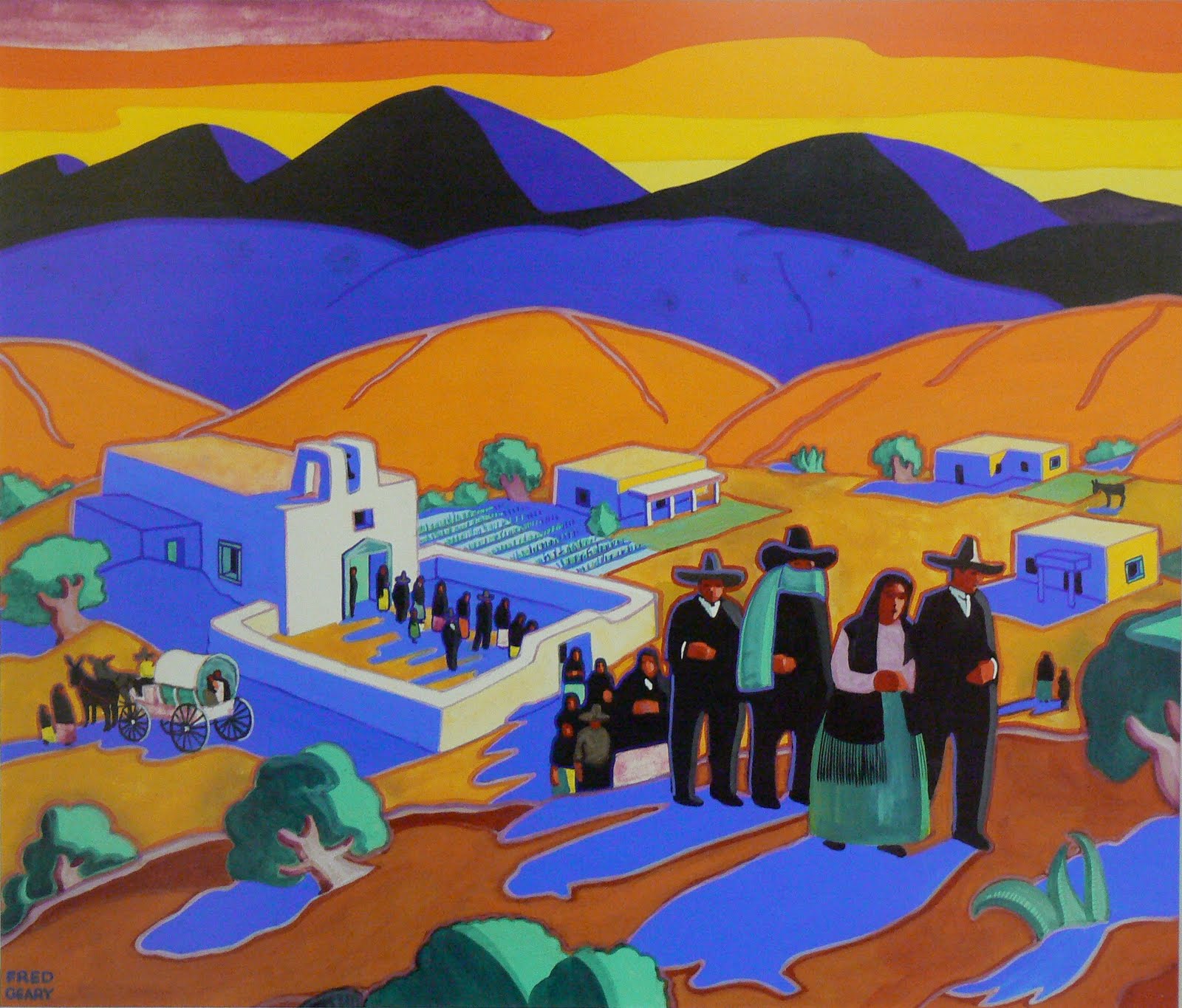
(Above) Sample of bright-colored Geary watercolor (courtesy of Carrollton Public Library, Carrollton Missouri, accessed May 15, 2010)
"Once again Colter brought in Harvey artist Fred Geary, this time to paint designs in turquoise, magenta, deep purple, orange, and green between the layers of double-glazed windows. The panes washed the lounge in the afternoon with tinted sunlight." p.247-248 [La Cocina Cantina, the new cocktail lounge at the Alvarado Hotel, Albuquerque, New Mexico, 1940.](Email from Betty Betty Upchurch, Librarian, Grand Canyon National Park Research Library, Grand Canyon, Wednesday, May 19th, 2010)
I believe more could be documented about Geary's work for the Harvey Company. Suffice it to say here, that he was, in fact, on the art department staff in Kansas City. This particular blog will focus on the history of his wood engravings. That said, the following email suggests that Geary was very mobile. Train travel on the Santa Fe routes was as important back then as the super highway we call the "Internet" today.
"I do not know if Fred Geary had a residence in Arizona or not. However, I do know that Mary Colter had a residence in Kansas City, but was almost never home. She was constantly on the Santa Fe trains or staying in Fred Harvey hotels the entire time she worked for the company. Possibly, Fred Geary had a similar arrangement and lived in the Harvey hotels."
(Email from Betty Upchurch, Librarian, Grand Canyon National Park Research Library, Wednesday, May 19th, 2010)
Pueblo image by Fred Geary, click HERE
-------------------------------------------
For those that missed the original C-SPAN2 Book TV broadcasts, author Stephen Fried's presentation on "Appetite for America: How Visionary Businessman Fred Harvey Built a Railroad Hospitality Empire That Civilized the Wild West" is now available online via streaming video by clicking the video link in the upper right column of that page:
Click HERE to view Appetite For America - BookTV - C-Span Video Library (video is 49 minutes)
"(Mr) Harvey spent a enormous amount of his life on the road. He was a railroad-warrior. He was a freight agent for the railroad for almost twenty years, before he started the restaurant empire you all know him for."
Stephen Fried, adjunct journalism professor at Columbia University Graduate School, recounts the life of Fred Harvey, one of the earliest innovators of the American hospitality industry. Mr. Harvey, was the proprietor of sixty-five restaurants and lunch counters along the Santa Fe Railroad and several hotels from Chicago to Los Angeles. Mr. Fried examines how Fred Harvey's restaurant and hotel locations dovetailed with westward expansion and how the Harvey House became a part of the American lexicon and a precursor to today's fast food franchises. Stephen Fried discusses his book at Union Station in Kansas City, Missouri. (email link from Brian Kreimendahl, Edgewood, New Mexico, accessed Monday, April 19, 2010)
10 Great Places to follow Fred Harvey's Old West tracks, click HERE.


