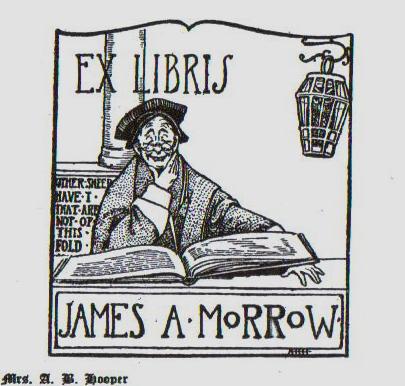
 When Sheldon Cheney folded up shop in May of 1910, he hoped another like-minded person would continue his work. Ten months later, the correspondence address changed from Berkley, California to Kansas City, Missouri. The new editor was H. Alfred (Fred) Fowler. Under his stay The Bookplate Booklet looked and felt exactly the same. There was an index page, an index to the Illustrations, a request for literary contributions, and news from around the bookplate world. Such as, "The Association Book Company of New York under James F. Drake, has just published a catalogue of proofs and prints by English and American Engravers from Mr. Spenceley's personal collection." Or, "The
 Graphic Arts and Crafts Year Book for 1909, a review of the engravers, printing, and allied industries, published at Hamilton, Ohio should be of special interest to bookplate designers....." Ads were placed by E. Lister of 104 Manchester in Oldham, England offering a "Catalouge of 2,000 Bookplates" to be mailed free to any part of the world; "Bookplates of Well-Known Americans" by Clifford N. Carver of Princeton, New Jersey; "Masonic Book-Plates" by A. Winthrop Pope, out of Newton, Massachuesttes; "Indiana Bookplaters" by Miss Esther Griffin White, with plates by Meredith Nicholson, James Whitcomb Riley, Gearge Barr McCutcheon, Edward Eggleston, Booth Tarkington, David Stuart Jordon, William Dudley Foulke, and Gov. Thomas R Marshall are reproduced
 in this Hoosier book; Frank B. Siegrist, a Bookplate Engraver from Kansas City; and Specialty Printing by Frank V. Barhydt of Kansas City printed the Booklet. There were bookplate owners that wanted to exchange plates with other collectors. Such as, "Harold G. Rugg, Dartmouth College Library, Hanover, N.H: exchanges the two Darmouth College plates by J. W. Spenceley for plates by the above-named artists "(Feb. 1908, Vol.2, No.1). Of note, exchange requests came as near as Lawrence, Kansas and from as far as Vienna, Austria. Fowler himself placed an ad requesting book-plates.
Fowler tried on a couple occasions to bring something special to his readers.
 Take the inked impression from the original copperplate done by Miss Bertha Gorst. It took special steps to insert that etching proof into the book (Bookplate Booklet, September 1911, Volume 4, Number 3, page thirty-five). The text read: "Although more widely known for her "Etchings of Chester," Miss Bertha Gorst, who is an associate of the Royal Society of Painter-Etchers and a member of many other well-known societies and associations of artists, has done some very creditable work in the field of book-plates.The "Etchings of Chester" are views of historical places in and about that quaint old town, and so faithfully do they render the spirit of the subjects that their depiction of the old buildings seems to express their very atmosphere of antique and legendary suggestion. And this same elusive quality is an attraction in many of her book-plates, one of them being the Gwendoline Buckler, of which we present an impression from the copperplate. This plate shows a view of Nuremberg taken from Durer's "St. Anthony"--it has been the subject for much comment on the part of ex libris critics and was at one time given honorable mention in the German Ex Libris Society Journal." In 1912 Fowler went on to publish a small folio of seven original copper etching impressions by Gorst with tissue guards to each with a facing page quoting a passage of John Ruskin. That work was called Gothic Bookplates.
Take his Ex Libran experiment published in 1912 on his private press. He limited the edition to 400 copies and printed it on Italian hand-made paper. He wanted the volume to have a one-of-a-kind appearance, something collectors would be privileged to own. Fowler personally attended to every detail, including setting the type, sewing the covers, and pasting the inserts.The type font looked like a medieval manuscript. The contents, surprisingly enough, continued advocating the engravers of bookplates. Click on link to view the Ex Libran for yourself.
Karl Marxhausen comments: To understand to hand printing process of a copperplate etching and a woodblock I have included a link to Bill Ritchie's video at Print Universe. There is the dampening of special paper, and the alignment of plates, but it will give you a better idea of the steps etching printers go through to produce a single print. Another contemporary video shows the hand-stitched book-making process Fowler "might" have used to create his Ex Libran volume.


